
From assumptions to a user-informed AI experience
How I redesigned an AI-assisted note experience around the workflows and needs uncovered through user research.
The Product
An AI-assisted note generation application for a health insurance company, designed to help users create clearer, more consistent notes while reducing repetitive writing. Users could draft notes, have AI revise them into patient-friendly language, and simplify individual medical terms directly within the editor.
I led user research and workflow analysis to identify gaps in the existing experience, then turned those insights into a redesigned workflow, interaction model, and UI.
Research revealed a misalignment
We evaluated the current experience and interviewed users to understand their workflows, needs, and where the product fell short. What we found challenged the assumptions behind the existing experience.
Users had different ways of creating notes
Users used different note styles. Some used personal templates, while others wrote from scratch, resulting in inconsistencies.
Users needed a shared structure that could bring consistency without forcing them into a rigid workflow.
Users wanted AI to assist them in their work
Users saw an opportunity to save time on repetitive cases with AI, but they still needed to review the content and make the final decision themselves.
AI needed to work alongside users, with enough transparency and control for them to review its output confidently.
Some features didn't match user needs
Some existing features were designed around assumptions about what users needed but didn't always support how they actually worked.
We needed to understand the underlying task before deciding what a feature should do.
Research changed the direction
What we learned showed that improving the existing experience wasn't enough. The product needed to be realigned around how users actually worked, what they needed from AI, and the tasks they were trying to accomplish.
Instead of refining the existing experience, we redesigned it around the needs we uncovered.
Designing around what we learned
With the product direction realigned, we translated the research findings into three focused design decisions: creating a consistent starting point, making AI-assisted writing easier to review, and helping users simplify language in context.
Shared templates
Users took different approaches to creating notes, resulting in inconsistent report structures.
We introduced shared templates based on the common workflow we identified. Templates gave users a consistent starting point while remaining optional for those who preferred their own approach.
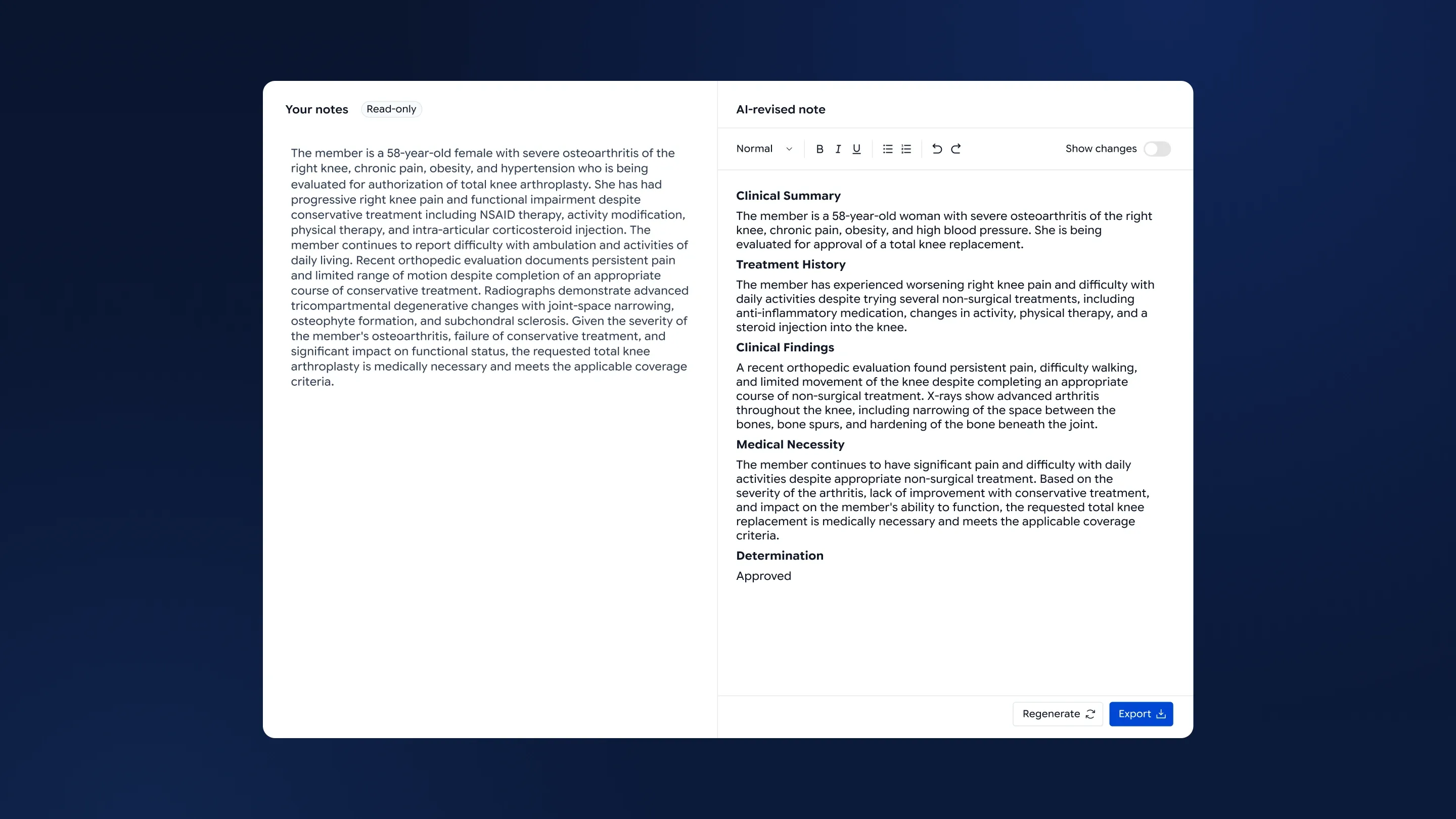
AI-revised notes editor
Users wanted AI to reduce repetitive writing, but they still needed to understand, review, and control the final output.
I designed the editor layout to keep the user's original notes visible alongside the AI-revised version. Meaningful changes could be highlighted for review, while the revised note remained editable so users could make their own adjustments before accepting it.
Simplify the text
Users needed simpler alternatives they could apply directly to their notes rather than interrupting their workflow to rewrite complex language.
I brought text simplification directly into the editor. Users could select a word or phrase and receive simpler alternatives, then insert their preferred option into the note.
The project moved the product from an assumption-driven experience toward a workflow grounded in user needs.
A more consistent workflow
Shared templates gave users a structured starting point while preserving flexibility in how they created notes.
More transparent AI assistance
Users could review AI-revised notes alongside their original drafts, see what changed, and edit or accept the output before finalizing their notes.
A clearer path for language simplification
Users could simplify words directly in the editor, rather than interrupting their workflow.
After the handoff, the client continued to evolve the product with additional features and refinements based on their needs.
Post-launch metrics were not available to our team after handoff, so we have not attributed quantitative improvements to the redesign.
AI should work with people, not for them
Users need transparency and control to work confidently with AI-generated content. The best AI experiences support human judgment rather than replacing it.
Research can change what you build
This project reinforced that assumptions can lead to solving the wrong problem. Talking to users helped us uncover real needs and change the product's direction.